Industries All industries
The carbon footprint of cheese is decided in the milking parlor, not the truck
Milk drives more than four fifths of a cheese's emissions, and how much milk a cheese needs depends on its family. What that means for makers, mongers and buyers.
 Claire SikoravBy invitation
On this page
The last time I said out loud that cheese is not vegetarian, six people who make and sell cheese for a living looked at me as though I had picked the wrong word. The fromagère on my street was kinder about it. "You mean vegan?" she asked. No: vegetarian. Most French cheese is set with rennet, rennet is an extract of the stomach of an unweaned calf or kid, and you cannot get it without slaughtering the animal.
Cheese is full of gaps like that, and the one that matters for anyone counting carbon is how many liters of milk are used to produce one kilogram of finished product. A 40-kilogram wheel of Comté is 400 liters of milk, and that milk was emitted, so to speak, long before the wheel left the farm. Beside it, the refrigerated truck that delivered the wheel is a rounding error.
I mapped France's 58 protected cheese appellations (AOP, AOC and IGP) and several hundred producers by hand, and learned the structural fact the slow way: every family of cheese is a different quantity of milk in disguise. That quantity, more than anything that happens afterward, sets the carbon number.
The milk does the emitting
The public French database Agribalyse (version 3.2, maintained by ADEME) puts hard cheese at 6.28 kg of CO2-equivalent per kilogram, and attributes about 83% of that to the farm stage. A peer-reviewed study of cheddar found the same shape: 14.02 kg CO2-equivalent per kilogram over the full life cycle, with milk production responsible for 86% of it. An Italian assessment of Grana Padano, a long-ripened hard wheel, landed between 16.96 and 23.07 kg CO2-equivalent per kilogram depending on scenario. The absolute numbers differ, methodologies and farms differ, but the proportion barely moves: the farm dominates everything.
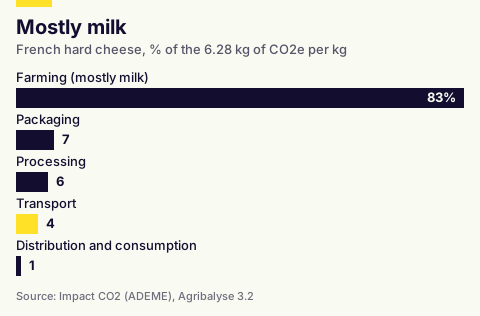
The reasons are biological rather than industrial. Cows, goats and ewes are ruminants, and rumination produces methane; growing and buying their feed carries its own emissions; manure adds more. In the cheddar study those three lines, enteric fermentation, feed, and manure management, are nearly the whole farm stage. None of them can be engineered away in the dairy; they can only be improved on the farm, through feed choices, herd health and longevity, manure handling and grazing practice.
Good to know: this is why "local" and "low-carbon" are not synonyms for cheese. A high-milk wheel from the next valley can carry several times the footprint of a soft cheese that crossed the country. Distance is visible; milk intensity is not; the milk intensity wins.
A cheese is a quantity of milk in disguise
Concentration is what cheesemaking is. It takes 10 to 12 liters of milk to make one kilogram of a pressed cooked cheese, while fresh and soft cheeses, which keep much more of their water, need markedly less milk per kilogram. Since the milk carries the emissions, the carbon ranking of cheese families follows the milk ranking almost mechanically: fresh and soft cheeses at the low end, pressed and long-ripened wheels at the top, with blues and washed rinds in between.
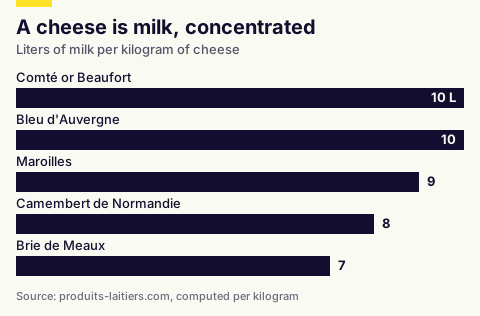
Nothing in that ranking is a verdict on what anyone should eat or sell. A Comté concentrates more milk per kilogram in the same way it concentrates more of everything else per kilogram; it is also eaten in smaller portions than fresh cheese. But for anyone doing carbon accounting on a dairy portfolio, the practical rule is plain: classify by cheese family first. Two suppliers of the same family differ by farm practice; two families differ by construction.
The animal matters less than the yield
The obvious next question is whether the species changes the answer. Per liter, small ruminants look worse than cows. A 2022 study in Animals of dairy sheep and goat flocks in Castilla-La Mancha put Manchega sheep at 3.78 kg CO2-equivalent per liter of fat- and protein-corrected milk, Lacaune and Assaf at 2.77, and Florida goats at 3.06, with simulated scenarios spanning 2.01 to 5.62. Cow milk sits well below that range.
Then the yield runs the other way. Ewe milk is far richer in fat and protein, and since cheese is essentially the dry matter of milk, a kilogram of it takes much less. Roquefort takes about 13 liters of ewe milk for a three-kilogram loaf, a little over four liters per kilogram, against 10 to 12 for a pressed cooked cow's cheese. Goat cheese generally lands between five and seven.
So the ranking per liter and the ranking per kilogram of cheese are not the same ranking, and the two effects push against each other. The published figures cannot tell you precisely how much of the gap they close, because multiplying one study's liter by another study's yield is not a life-cycle result. My own answer, after several hundred producers, is that they close far more of it than anyone expects. By the time you are holding a kilogram of finished cheese, the species is almost never what separates two products. The family and the farm are.
That gives the working rule. Compare per kilogram of finished cheese, and inside the same family. A per-liter figure tells you about a farm, not about a product on a shelf, and a buyer choosing goat over cow on carbon grounds is optimizing a number that will not survive the conversion.
Rennet, and why cheese is not vegetarian
Back to the conversation I lose friends with. Yogurt is the one dairy product set without a coagulant, by lactic fermentation alone. Everything else uses one, and in France that usually means rennet. French law still defines it by a decree of 25 March 1924, as an extract of the abomasum, the fourth stomach, of young bovids. The specification for most French PDO cheeses (Protected Designation of Origin, AOP in French) requires that animal rennet specifically, so it is a rule of the appellation rather than a choice the cheesemaker makes. Pressed cheeses are rennet-set and take a far larger dose than a lactic curd, which coagulates mostly on its own acidity. So the cheeses that carry the most milk are also the ones that carry the most rennet, which is a coincidence I have never found a cheesemonger eager to discuss.
Microbial and plant coagulants exist, and industrial cheesemaking uses them widely, which is what makes a vegetarian cheddar possible. PDO specifications generally exclude them, and the makers' argument is that they ripen differently. One consequence is worth sitting with: Swiss public broadcaster RTS reported in 2026 that Swiss PDO specifications mandate animal rennet which can be, and often is, imported from New Zealand calves. The milk must come from the next valley. The coagulant may cross the planet.
For carbon accounting the point is not the rennet itself, which is a rounding error by mass. It is that the calf is not a byproduct of nothing. Keeping a cow in milk means a calf every year, and dairy life-cycle assessment has to decide how much of the herd's emissions belong to milk and how much to the meat that leaves with that calf. Allocation choices of exactly that kind are why two credible studies of the same cheese can disagree by several kilograms, and why a supplier's number is only readable next to the method that produced it.
Good to know: if a client or a tender asks whether your dairy range is suitable for vegetarians, animal rennet is the blocking question, not the milk. Microbial coagulant is the answer, and it will usually rule out the PDO version of the same cheese.
What the dairy and the cave actually control
Once milk arrives at the dairy, the remaining emissions are conventional industrial lines, real, improvable, and small beside the farm stage. Heat for the vats and pasteurization where it applies. Cold, everywhere and permanently: ripening cellars, storage, and the cold chain to the shelf, which add electricity and refrigerant leakage of the kind any industrial site would recognize. Whey, the liquid the curd leaves behind, is worth a line of its own: sold or processed as an ingredient, it turns a waste stream into a co-product that carries part of the allocation; dumped, it is both a pollution problem and an accounting loss.
A long affinage extends the electricity bill, which is why a 9-month wheel like Grana Padano sits where it does in the studies. The energy levers are the familiar ones, heat recovery on the vats, cellar insulation, refrigerant maintenance, and they are worth taking, while remembering their ceiling: run a perfect dairy on renewable electricity and the cheese still carries its milk.
Waste is a carbon line, not just a margin line
For distribution, the arithmetic has a sharp consequence. Every kilogram of cheese thrown away wasted 10 liters of milk's worth of emissions upstream, so shrink is a carbon line, not just a margin line. Cutting waste at the counter, portioning to real demand, and selling the heel of the wheel do more for a fromagerie's footprint than any delivery-route optimization, and they are decisions a shop actually controls. The same holds one step further down: the cheese that reaches a fridge and gets eaten has, in carbon terms, succeeded; the one scraped into the bin has not.
For CSR teams with dairy in the portfolio, the reporting translation is straightforward: put your effort into supplier data for the milk, classify products by family, and count waste rates as a first-class metric.
For the rest of us, the comfort is real. Once the milk's carbon footprint has been accounted for from farm to cellar, there's nothing left to do with the cheese except eat it.
Sources
- Impact CO2 (ADEME), hard cheese, Agribalyse 3.2
- Energy demand and carbon footprint of cheddar cheese, Energy Procedia
- Carbon footprint of dairy milk and Grana Padano PDO cheese, Animals (MDPI)
- Quantité de lait par fromage, produits-laitiers.com
- GHG emissions from dairy small ruminants in Castilla-La Mancha, Animals (MDPI), 2022
- Roquefort, le Guide du Fromage
- Swiss PDO cheeses made with New Zealand rennet, RTS
- Les Fromages du Bonheur, the interactive map of French cheeses