Industries Electronics, Industry & Equipment
Finding the PFAS in your products: a supplier inquiry that gets answers
A PFAS supplier inquiry scoped by component family, with the OECD definition and thresholds attached, gets answers a generic questionnaire never will.

On this page
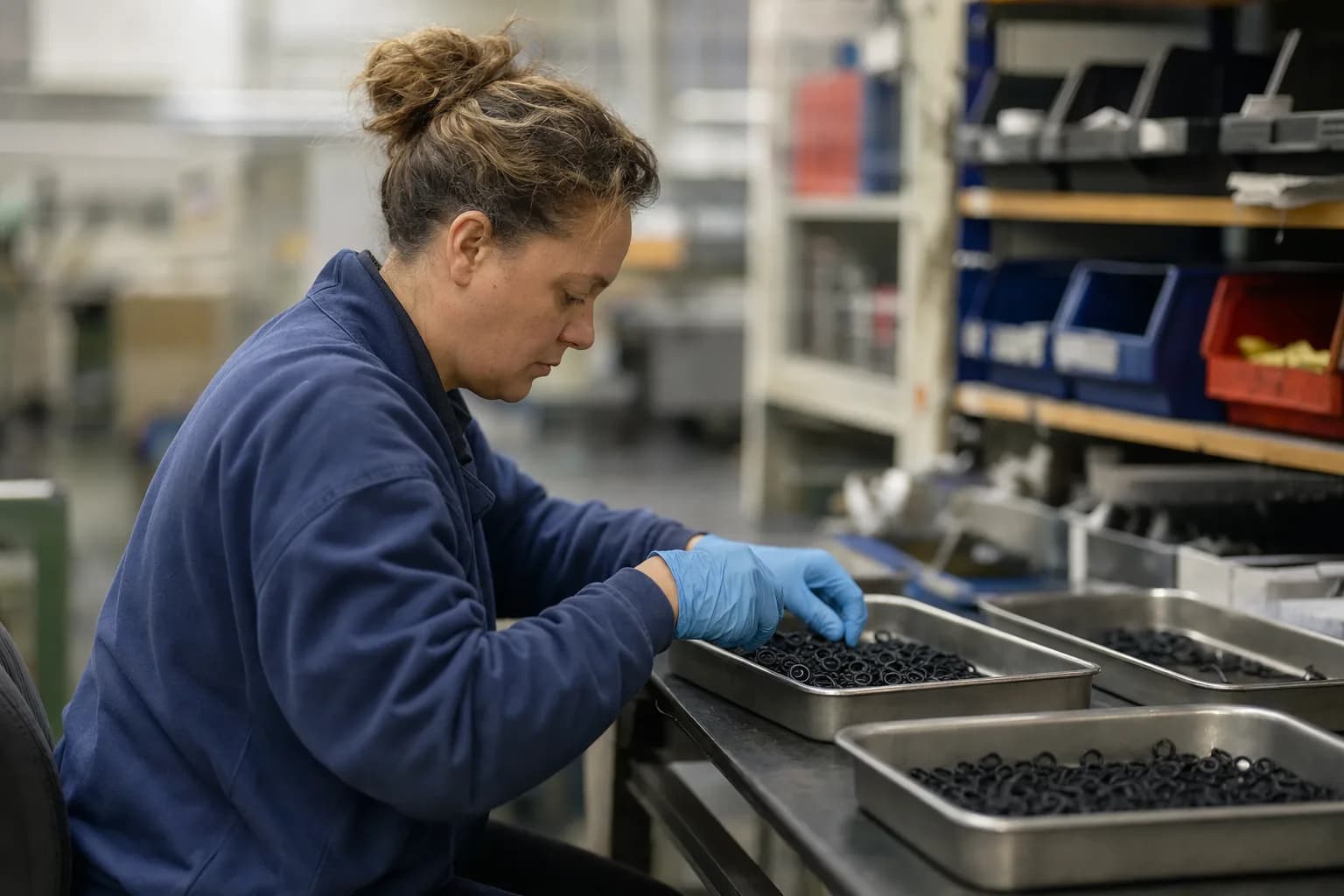
In a parts bin, an EPDM O-ring and an FKM O-ring look identical. The first contains no fluorine at all. The second is a fluoroelastomer, which makes it PFAS through and through. No visual check and no standard bill of materials will tell them apart for you. The only way to know is to ask the company that made the part, and to ask well.
The clock is running. The proposal for a universal PFAS restriction under REACH, submitted in January 2023 by five national authorities (Denmark, Germany, the Netherlands, Norway, and Sweden), covers more than 10,000 substances. ECHA's Committee for Risk Assessment (RAC) adopted its opinion on March 2, 2026, the Committee for Socio-Economic Analysis (SEAC) published its draft opinion on March 26, and the consultation on that draft closes on May 25, 2026. The decision then passes to the European Commission, with application expected no earlier than around 2029 once transition periods are counted. Procurement teams at large customers are not waiting: the PFAS question is already appearing in their supplier questionnaires.
Where PFAS hide: four component families
Industrial PFAS are materials chosen on purpose, for properties nothing else delivers at the same price: chemical resistance, heat resistance, non-stick behavior, dielectric performance. Which is why they sit exactly where an equipment or electronics manufacturer would least think to look for a "chemical."
| Component family | Typical fluorinated materials | What they are there for |
|---|---|---|
| Coatings and surface treatments | PTFE, FEP, PFA; water and oil repellents | Non-stick, chemical resistance, low friction |
| Seals, gaskets, membranes | FKM, FFKM, PTFE | Resistance to oils, solvents, and heat |
| Cables and wire insulation | PTFE, FEP, ETFE | High-temperature rating, dielectric insulation |
| Electronics and batteries | PVDF electrode binders, PFPE greases, fluorinated heat-transfer fluids | Chemical and thermal stability |
Good to know: under the definition the OECD (Organisation for Economic Co-operation and Development) published in 2021, fluoropolymers are PFAS. A supplier who answers "no PFAS" about a PTFE-lined valve is not necessarily acting in bad faith. They are answering against an older, narrower definition, usually one limited to a handful of acids like PFOA and PFOS.
The definition and the thresholds are the question
The OECD's 2021 definition is structural: a PFAS is any fluorinated substance containing at least one fully fluorinated methyl carbon (-CF3) or methylene carbon (-CF2-) with no hydrogen, chlorine, bromine, or iodine attached to it. The universal restriction proposal works from that scope, and it sets three concentration limits for what counts as PFAS-free: 25 ppb for any single PFAS measured by targeted analysis, 250 ppb for the sum of targeted PFAS, and 50 ppm for total PFAS, polymers included. That third limit is checked in practice through a total fluorine measurement, because targeted analysis cannot see fluoropolymers.
Send the definition and the three thresholds with every question you ask. A supplier cannot answer "does this contain PFAS" honestly without knowing which PFAS and above what level, and every ambiguity you leave open will be resolved in favor of the shortest possible reply.
Scope the inquiry by component family, not "any PFAS anywhere?"
A blanket question to your whole supplier base produces three kinds of answers, all useless: silence, a one-line "our products comply with REACH," and the occasional over-declaration from a supplier who lists every substance they have ever purchased. The fix is to make the question small enough to answer.
- Screen your bill of materials for the four families above. You are not looking for substances at this stage, only for parts: anything coated, anything that seals, anything insulated, anything electrochemical. The annexes of the restriction dossier, which inventory PFAS uses sector by sector, from textiles to metal plating to electronics, make a good checklist for uses you might have missed, lubricants and greases being the classic blind spot.
- Ask one question per component family, naming the part. "Does the coating of part 88-412 contain any substance meeting the OECD 2021 PFAS definition (at least one fully fluorinated -CF3 or -CF2- carbon), above 25 ppb per substance, 250 ppb as a sum, or 50 ppm total PFAS, polymers included? If yes, which substances, at what concentration, and in what function?" A question that specific is answerable in one email by the right person at the supplier.
- Record the answer, the definition version, and the date. "PFAS-free" means nothing on its own; "no PFAS per the OECD 2021 definition at the proposal's thresholds, declared on this date, for this part number" is data you can defend in front of a customer or an auditor.
"Proprietary formulation" is not a dead end
The most common non-answer is the appeal to trade secrets. Take it seriously, then route around it: you are not asking for the recipe, you are asking for a yes or no against a public definition and a public threshold. Three fallbacks, in order of preference:
A negative declaration. The supplier states that the part contains no substance meeting the OECD 2021 definition above the three thresholds, without disclosing what it does contain. This protects the formulation completely and answers your question completely.
A material-level answer. Often the material name is the answer. A gasket declared as FKM is a declared PFAS, whatever else is in the compound. A supplier willing to name the polymer family has told you most of what you need.
A total fluorine measurement. When the supplier will say nothing, a total organic fluorine analysis on the part itself, commissioned by you, settles the question of whether fluorinated chemistry is present at all. It does not identify substances, but it turns a refusal into a number.
A supplier who declines all three for a coated or sealing part is telling you something. Treat it as a sourcing risk to escalate, not as a closed file.
The universal restriction will not apply tomorrow, and its final derogations are still being argued over in the current consultation. The deadlines that already exist are narrower but real: the PFHxA restriction adopted in September 2024 (Regulation (EU) 2024/2462) starts applying to its first uses in 2026. Start the inquiry now with your ten highest-volume coated, sealed, and insulated parts, and budget a season for it rather than a week. The customer questionnaires will not wait for the Commission.
FAQ
Are fluoropolymers like PTFE considered PFAS?
Yes. Under the OECD's 2021 definition, any substance with at least one fully fluorinated methyl or methylene carbon atom is a PFAS, which includes fluoropolymers such as PTFE, FEP, PVDF, and fluoroelastomers like FKM. The universal restriction proposal under REACH uses this scope.
What can we ask a supplier who refuses to disclose a proprietary formulation?
Ask for a negative declaration: a statement that the part contains no substance meeting the OECD 2021 PFAS definition above 25 ppb per substance, 250 ppb as a sum, or 50 ppm total PFAS including polymers. It answers the compliance question without revealing the recipe. Alternatively, ask for the polymer family of the material, or commission a total organic fluorine analysis on the part.
When will the universal PFAS restriction apply?
No date is set. ECHA's Risk Assessment Committee adopted its opinion on March 2, 2026, and the Socio-Economic Analysis Committee published its draft opinion on March 26, 2026, with a consultation running to May 25, 2026. The European Commission decides after the final opinions, and application is expected no earlier than around 2029, with transition periods varying by sector.
Which components of an industrial product most often contain PFAS?
Four families account for most cases: coatings and surface treatments (PTFE, FEP, PFA), seals and gaskets (FKM, FFKM fluoroelastomers), cable and wire insulation (PTFE, FEP, ETFE), and electronics, including PVDF battery binders, fluorinated greases, and heat-transfer fluids.